Have you ever searched “best cardiologist near me” or “fever specialist in Delhi” on Google? Your patients are doing the same thing — right now, on their smartphones.
India has over 900 million internet users, and more than 73% of urban patients search online before booking a doctor’s appointment. If your hospital, clinic, or healthcare brand is not showing up in those search results, you are losing patients to competitors who are.
Digital marketing for healthcare in India is no longer just an option — it is the difference between a full OPD and empty waiting rooms. Whether you are a solo practitioner, a multi-specialty hospital, or a healthcare startup, this guide covers every strategy you need to grow your patient base, build trust, and stay ahead in 2026.
Why Healthcare Needs Digital Marketing in India
India’s healthcare industry is on an extraordinary growth curve. The sector is projected to reach $638 billion by 2026, with the digital health segment alone expected to grow at a CAGR of 25% through 2033.
But beyond the big numbers, what matters for hospitals, clinics, and doctors is this: patient behaviour has changed permanently.
Here is what the data tells us:
- 73% of urban Indian patients research doctors and hospitals online before making a decision
- More than 70% of all patient searches happen on mobile phones
- Patients read Google reviews, check credentials, watch doctor videos, and compare hospitals — all before picking up the phone
- Healthcare companies that invest in digital marketing see up to 5–8x higher ROI compared to those that rely on traditional methods alone
The patients are online. The question is: are you?
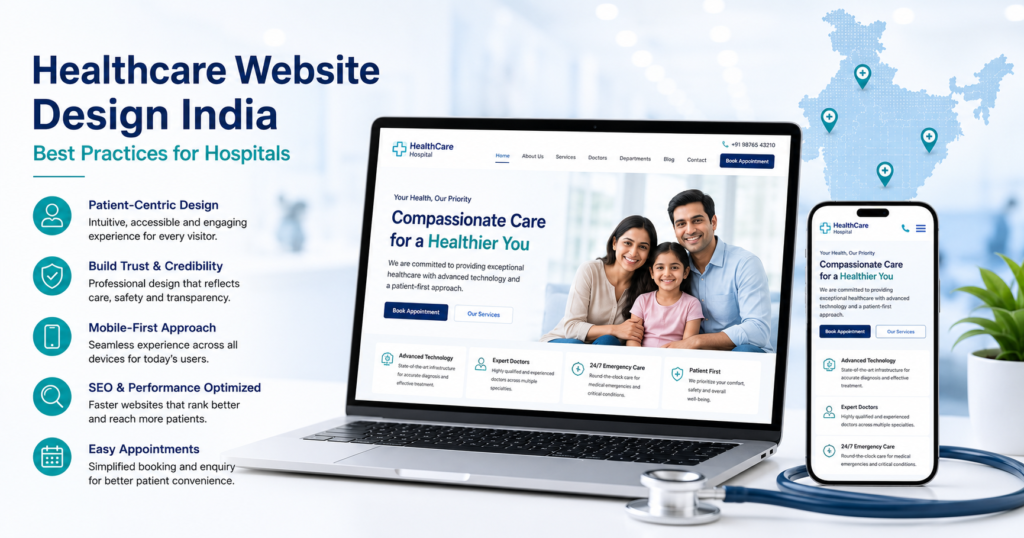
Build a Patient-First Website: Your Digital Reception Desk
Your website is the first impression most patients will have of your practice. A slow, outdated, or confusing website loses patients within seconds. A clean, fast, and informative website builds trust before the patient even calls.
What every healthcare website in India must have:
- Mobile-responsive design — Over 70% of patients browse on smartphones
- Fast loading speed — A page that takes more than 3 seconds to load loses visitors
- Doctor profiles with credentials — MBBS, MD, specialisation, experience, and photo
- Online appointment booking — Available 24/7 without needing a phone call
- Department and service pages — Clearly explaining every specialty and treatment offered
- NABH accreditation or certifications displayed prominently
- Patient testimonials and before/after case stories (with consent)
- WhatsApp chat button for instant queries
- Contact and location map for every branch
Think of your website as your most hardworking team member. It works 24 hours a day, 7 days a week, never asks for a raise, and introduces your practice to hundreds of patients every single day.
Local SEO: Be Found When Patients Search Near You
When a patient types “best gynaecologist in Pune” or “diabetologist near me” on Google, they have very strong intent to book an appointment. Getting your clinic to appear at the top of those results is the single highest-ROI digital strategy for any healthcare brand in India.
Local SEO for Clinics: Step-by-Step Setup Guide digiloom media
Set Up and Optimise Google Business Profile
Your Google Business Profile (formerly Google My Business) is what shows up in Google Maps and the local pack of search results. It is free to set up and incredibly powerful.
Make sure your profile includes:
- Correct clinic name, address, and phone number
- Category set to your specialty (e.g., “Cardiologist,” “Multi-Specialty Hospital”)
- Business hours including emergency hours
- High-quality photos of the clinic, reception, OPD, and doctors
- All services listed
- Responding to every patient review — positive or negative
- Google Business Profile Setup — Official tool for local SEO and Google Maps visibility.
Optimise Your Website for Local Keywords
Use phrases your patients actually search for:
- “Best skin specialist in [City]”
- “Affordable dental clinic in [Locality]”
- “Child specialist near [Area Name]”
- “Orthopaedic doctor in [City]”
Include these keywords naturally in your page titles, headings, and content — never forcefully.
Get Listed on Healthcare Directories
Being listed on popular platforms increases your visibility significantly:
- Practo — India’s most-used healthcare directory
- JustDial — High-traffic local listings
- Lybrate — Doctor profiles and online consultations
- Apollo 24/7, 1mg — For pharmacy and teleconsult reach
Make sure your name, address, and phone number (NAP) is identical across all platforms. Inconsistency confuses Google and hurts your rankings.
Google Ads for Healthcare: Instant Visibility for High-Intent Patients
SEO takes time. Google Ads (Pay-Per-Click) gives you immediate visibility at the top of Google for the keywords that matter most to your practice.
When someone searches “best IVF centre in Mumbai” or “knee replacement hospital Delhi,” your ad appears at the very top — before all organic results.
Best Practices for Healthcare Google Ads in India:
- Target specific medical keywords with high purchase intent (e.g., “LASIK eye surgery cost Hyderabad,” “hair transplant clinic Chandigarh”)
- Use location targeting to show ads only in your city or catchment area
- Run call-only ads for emergency services and OPD bookings
- Use ad extensions — Include your phone number, directions, and specific services
- Retarget website visitors who did not book an appointment on their first visit
Important: Google has specific healthcare advertising policies. Ads for certain medical services like abortion, addiction treatment, or clinical trials require pre-approval. Always work with a healthcare-specialised agency to stay compliant.
A well-run Google Ads campaign for a clinic in India typically generates a cost-per-lead of ₹200–₹800 — one of the most cost-efficient patient acquisition methods available.
Social Media Marketing for Healthcare: Build a Community of Trust
Social media is where patients form opinions about your brand — even before they visit. Hospitals and doctors that are active, educational, and engaging on social media are seen as more credible and approachable.
Facebook & Instagram
These are your primary platforms for patient engagement in India.
What to post:
- Health tips and preventive care advice
- Doctor introduction videos and behind-the-scenes clinic videos
- Patient success stories (with proper consent)
- Awareness posts for health events — World Heart Day, World Diabetes Day, etc.
- Myth-busting posts (“Can stress really cause a heart attack? Here’s the truth.”)
- Live Q&A sessions with your doctors
Facebook Ads allow precise targeting by age, city, health interests, and life events (like expecting parents for maternity services, or senior citizens for orthopaedic care).
Instagram Reels of short health tips, doctor introductions, and hospital tour videos generate strong organic reach and build familiarity with your brand.
YouTube
YouTube is the second-largest search engine in the world. When patients want to understand a procedure, they watch videos.
A doctor explaining “What happens during a cataract surgery?” or “How to manage Type 2 Diabetes through diet” — in simple language — positions your hospital as the expert they want to trust with their care.
For hospitals targeting corporate health packages, medical tourism, B2B healthcare services, or recruiting specialists, LinkedIn is a powerful and often underutilised channel.
Content Marketing: Educate Patients and Rank Higher on Google
In healthcare, the most trusted brands are the ones that educate. Content marketing is about creating helpful, accurate, and readable health information that your target patients are already searching for.
Google classifies all health-related content as YMYL (Your Money or Your Life) — meaning it holds healthcare content to a very high standard of accuracy and trustworthiness. Low-quality or misleading content gets penalised. High-quality, credible content gets rewarded with top rankings.
Blog content ideas for Indian hospitals and clinics:
- “10 Early Warning Signs of Kidney Disease You Should Not Ignore”
- “PCOD vs PCOS: What Every Indian Woman Needs to Know”
- “How to Choose the Right Hospital for Heart Surgery in India”
- “Dengue Fever: Symptoms, Treatment, and When to See a Doctor”
- “What to Expect After a Hip Replacement Surgery”
- “Common Myths About Diabetes — Busted by Our Endocrinologist”
Online Reputation Management: Your Most Powerful Marketing Tool
In healthcare, reputation is everything. A single bad review on Google can cost you dozens of patients. A strong collection of genuine positive reviews builds the social proof that makes patients choose you over a competitor.
How to manage your online reputation effectively:
- Ask every satisfied patient for a review — A simple WhatsApp message after discharge saying “Your feedback matters. Please take 2 minutes to share your experience on Google” works very well
- Respond to every review — Thank positive reviewers and professionally address negative ones. Never argue or get defensive
- Monitor mentions on Practo, Google, Facebook, and JustDial regularly
- Showcase testimonials on your website and social media (with patient consent)
- Resolve complaints offline first before they reach review platforms
Research shows that patients trust online reviews as much as personal recommendations from friends and family. Managing your reputation is not just marketing — it is patient care.
WhatsApp Marketing: Personal, Direct, and Incredibly Effective
India has over 500 million WhatsApp users. For healthcare brands, WhatsApp is the most personal and trusted communication channel available.
How healthcare providers use WhatsApp effectively:
- Appointment reminders and confirmations — Reduce no-shows with automated reminders sent 24 hours and 2 hours before appointments
- Post-consultation follow-ups — “How are you feeling today? Your next review is on [date]”
- Lab report delivery — Send digital reports directly on WhatsApp
- Health tips broadcasts — Weekly health tips sent to opted-in patient lists
- Emergency helpline — A dedicated WhatsApp number for urgent queries
- Chatbot integration — Handle appointment bookings, department enquiries, and basic FAQ responses 24/7
Use WhatsApp Business API for hospitals managing large patient volumes. Always ensure you are messaging only opted-in patients to remain compliant and maintain trust.
Video Marketing: The Most Trusted Healthcare Content Format
Patients are more likely to trust a hospital where they can see the doctors, the facilities, and real patient experiences — before ever stepping inside.
Video content types that work for Indian healthcare:
- Doctor introduction videos — 60 to 90 seconds, the doctor speaking directly to the camera in Hindi or regional language
- Procedure explanation videos — “What happens during an MRI?” or “How is a C-section performed?” — simple, calm explanations
- Patient testimonial videos — Real patients sharing their experience (the single most powerful trust-building content)
- Hospital tour videos — OPD, ICU, labour room, operation theatre — showing cleanliness and infrastructure
- Health awareness videos — Tied to seasonal health risks (monsoon diseases, winter respiratory infections, etc.)
- Live Instagram/Facebook sessions — Doctors answering patient questions in real time
YouTube Shorts and Instagram Reels are particularly effective in reaching younger patients and their family caregivers — the people who actually make the appointment booking decision.
Telemedicine Marketing: Reach Patients Beyond Geography
Telemedicine is one of the biggest opportunities in Indian healthcare marketing today. With platforms like Practo, Apollo 24/7, and independent teleconsult systems, doctors can now serve patients across India — and even NRI patients abroad.
How to market your telemedicine services:
- Dedicate a landing page on your website to teleconsultation with a clear booking system
- Promote tele-OPD slots on social media and WhatsApp
- Run Google Ads targeting patients in smaller cities who cannot travel to your specialty centre
- Offer first-consultation discounts to drive trial
- Create content specifically addressing conditions that are well-suited to teleconsultation — diabetes management, dermatology follow-ups, second opinions, psychiatry, and nutrition counselling
India’s telemedicine market is growing at over 21% annually — and the healthcare brands that establish a strong digital presence now will dominate this space for years to come.
Digital Marketing for Healthcare Channels — Comparison Table
| Channel | Best For | Cost | Time to Results | Patient Lead Quality |
|---|---|---|---|---|
| Local SEO | Organic discovery, long-term growth | Low (time investment) | 3–6 months | Very High |
| Google Ads (PPC) | Immediate high-intent patient leads | Medium–High | Immediate | High |
| Facebook/Instagram Ads | Awareness, speciality promotions | Medium | 1–2 weeks | Medium–High |
| Content Marketing | Trust building, Google rankings | Low | 3–12 months | Very High |
| WhatsApp Marketing | Patient retention, follow-up | Very Low | Immediate | High |
| YouTube Videos | Trust, patient education | Medium | 1–3 months | High |
| Reputation Management | Credibility, word-of-mouth | Low | Ongoing | Very High |
| Telemedicine Marketing | Geographic expansion | Medium | 1–2 months | High |
Dos and Don’ts of Digital Marketing for Healthcare in India
Healthcare marketing in India is regulated by the Indian Medical Council (Professional Conduct, Etiquette and Ethics) Regulations and monitored under Consumer Protection and Advertising Standards. Violating these can harm your reputation and invite legal trouble.
DO:
- Share educational health content
- Showcase doctor credentials and hospital accreditations (NABH, JCI)
- Display genuine patient testimonials with consent
- Use data and research to support claims
- Respond professionally to all reviews
DON’T:
- Claim guaranteed results or “100% success rate” for any treatment
- Disparage or compare negatively with competitor hospitals
- Use misleading before-and-after images
- Make false claims about treatments or medications
- Collect or use patient health data without explicit consent (HIPAA/DPDP Act compliance applies)
Why is digital marketing important for hospitals and clinics in India?
Because patients have changed. Today, more than 73% of patients research their doctor or hospital online before booking an appointment. Without a strong digital presence, even the best hospital loses patients to competitors who are more visible online. Digital marketing builds trust before the patient walks through your door.
What is the most effective Digital Marketing for Healthcare strategy for a small clinic in India?
For a small clinic with a limited budget, the highest-impact starting point is Local SEO + Google Business Profile + WhatsApp Business. Together, these three strategies ensure you appear in “near me” searches, build credibility through reviews, and communicate personally with patients — all at minimal cost.
How much should a hospital spend on digital marketing in India?
A reasonable benchmark is 2–5% of annual revenue allocated to digital marketing. For a small clinic, this could be ₹15,000–₹50,000 per month. For a multi-specialty hospital, ₹2–10 lakh per month allows for a comprehensive strategy across SEO, paid ads, content, and social media.
Is social media marketing effective for doctors?
Absolutely. Doctors who share educational content, health tips, and behind-the-scenes glimpses of their practice build enormous trust with potential patients. Instagram Reels and YouTube Shorts in particular have helped individual doctors build patient bases of thousands across India. Authenticity and consistency are the keys.
Can healthcare brands run Google Ads in India?
Yes, but with compliance requirements. Google allows healthcare advertising but restricts certain sensitive categories. Ads for hospitals, clinics, diagnostic centres, and general medical services are allowed. Always use a healthcare-experienced digital agency that understands Google’s medical advertising policies to avoid ad disapprovals.
How does online reputation management help a hospital grow?
Patients trust online reviews as much as personal recommendations. A hospital with 200+ genuine Google reviews averaging 4.5 stars will consistently attract more patients than a competitor with no online presence — even if the latter is clinically superior. Reputation management ensures your digital word-of-mouth matches the quality of care you deliver.
Conclusion
Digital marketing for healthcare in India has crossed the tipping point. Patients are searching online, comparing hospitals on Google, watching doctor videos on YouTube, and reading reviews on Practo — all before they make a single call.
The good news is that healthcare is a high-trust category, which means quality digital marketing creates compounding returns. Every blog post that educates, every review that reassures, every social media video that humanises your doctors — all of it builds a brand that patients choose again and again, and recommend to everyone they know.
The strategy is clear: Start with your website and Google Business Profile. Build your Local SEO and online reputation. Then layer in social media, content, video, and paid advertising as your budget grows.
Healthcare is personal. Digital marketing helps you show patients — before they ever visit — that they are in the right hands.
Ready to grow your patient base through digital marketing? Start by claiming and optimising your Google Business Profile today — it is free, takes less than 30 minutes, and is one of the highest-impact actions any clinic or hospital can take right now.